On cellular networks, a “bearer” is essentially a dedicated pipeline or tunnel established to carry data with specific quality-of-service rules. The term “Split Bearer” can be confusing initially because there are many different types of bearers layered on top of each other.
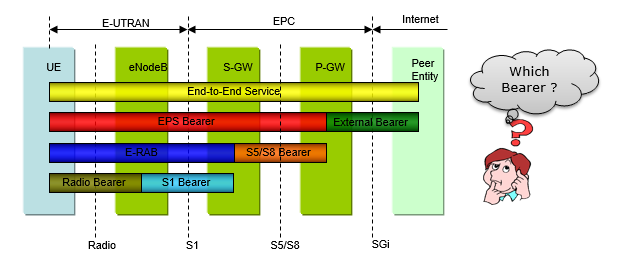 The first figure in the document illustrates the overall bearer hierarchy from the User Equipment (UE, like your phone) across the network to the internet:
- End-to-End Service: The highest level of connection.
- EPS Bearer: The bearer connecting the UE to the Packet Data Network Gateway (P-GW).
- E-RAB: The Radio Access Bearer connecting the UE to the Serving Gateway (S-GW).
- Radio Bearer: The specific over-the-air link between the UE and the cell tower (eNodeB).
- S1, External, and S5/S8 Bearers: These are backend network tunnels connecting different core network elements.
Note
When we discuss a “Split Bearer” in 5G, the split is specifically happening within the Radio Bearer.
The Deployment Context: Non-StandAlone (NSA)
To understand why a bearer needs to split, we have to look at how 5G is being deployed.
- In the early stages of 5G New Radio (NR) deployment, telecom operators usually deploy 5G as a supplementary node to an existing LTE network.
- The LTE tower acts as the Master Node (MN), and the 5G tower acts as the Secondary Node (SN). This hybrid architecture is called NSA (Non-StandAlone) deployment.
In this Multi-Radio Dual Connectivity (MR-DC) setup, the UE can utilize three different types of bearers:
- MCG Bearer: Master Cell Group bearer (runs entirely through the LTE node).
- SCG Bearer: Secondary Cell Group bearer (runs entirely through the 5G node).
- Split Bearer: A single bearer that shares its traffic across both the LTE and 5G nodes.
The Exact Point of the Split
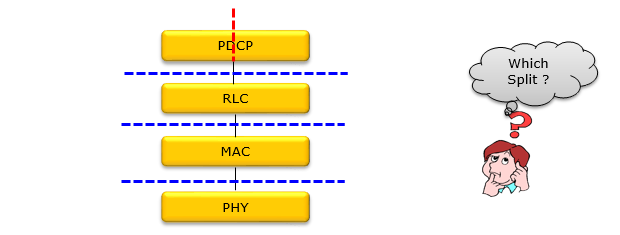
Inside the Radio Bearer, data flows downward through a protocol stack consisting of the PDCP, RLC, MAC, and PHY layers. While there are different ways network engineers could technically split a signal, the document specifies that the Split Bearer separates the data stream precisely at the PDCP (Packet Data Convergence Protocol) layer.
Network Deployment Scenarios
The document highlights two specific network layouts where a Split Bearer is typically utilized:
- Case 4: This involves an LTE eNB and a 5G gNB connecting back to an older LTE Core network (EPC). This is the most standard scenario for early 5G NSA rollouts. In this case, the data flow is aggregated across the LTE eNB and NR gNB via the EPC.
- Case 6: This involves an upgraded eLTE eNB and a 5G gNB connecting back to a newer NextGen Core (5G Core). Here, the data flow is aggregated across the eLTE eNB and NR gNB via the NextGen Core.
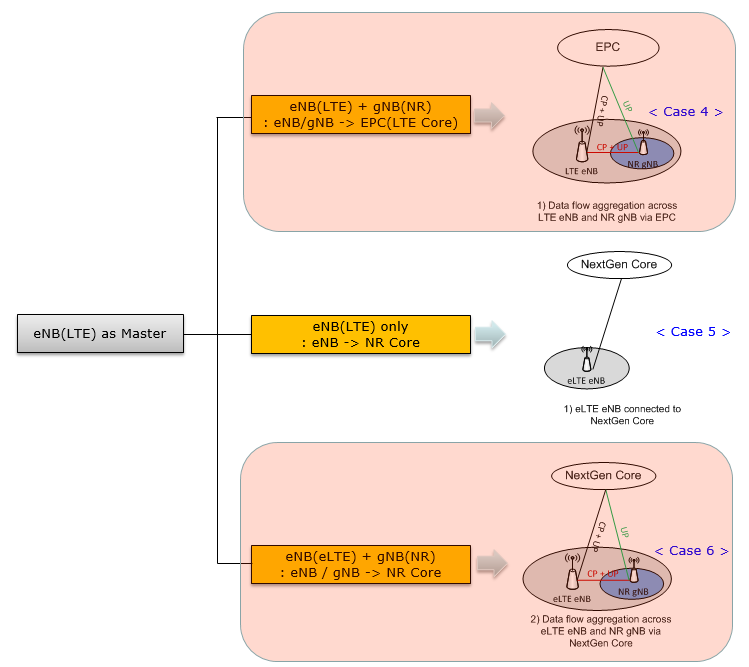 It is important to note that even if a network uses Case 4 or Case 6, it is not forced to use a split bearer; it is merely an option among others, like using purely MCG or SCG bearers.
Detailed Data Path Architecture
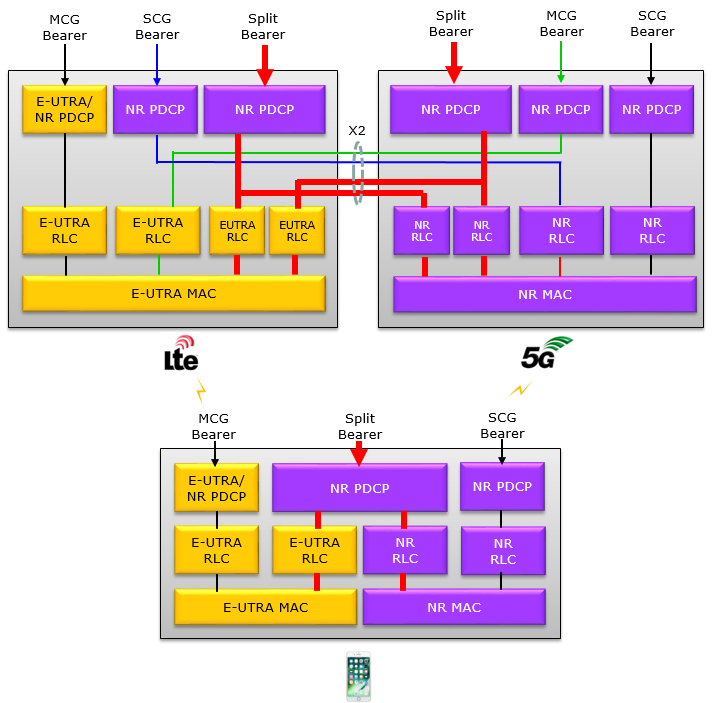 When looking at the detailed block diagrams for the data path, a critical rule emerges for Split Bearers:
- The system uses the NR PDCP (the 5G version of the PDCP protocol) for both the LTE Anchor and the NR paths.
- The NR PDCP layer handles the splitting, sending a portion of the data down to the LTE RLC layer and the remaining portion to the NR RLC layer.
Taking an even closer look inside the transmitting PDCP entity, the actual splitting mechanism, labeled “Routing/Duplication”, happens at the very bottom of the process.
- First, the data goes through sequence numbering, header compression, integrity protection, and ciphering.
- After the PDCP header is added, the routing block dynamically decides which physical path each packet will take.
- On the receiving end, the counterpart PDCP entity must gather the packets from both the LTE and NR radio interfaces, reorder them, and decipher them back into a single stream.
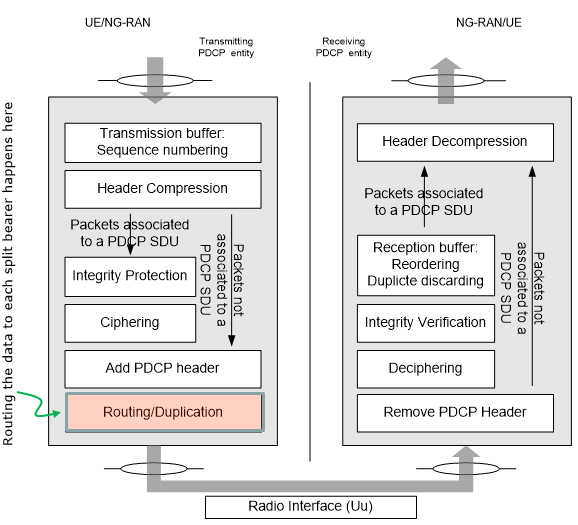
Managing Asymmetry and RLC Confusion
The document touches on a complex scenario: What happens if the network configures a Split Bearer for the downlink (sending data to your phone) but not for the uplink (your phone sending data back)?.
The author initially worried this would confuse the UE’s RLC layer, but concludes it wouldn’t be an issue. Even if the split is downlink-only, the UE must still manage and acknowledge two separate receiving streams (one via LTE, one via NR). A scenario where a downlink is split but the corresponding receiving paths don’t exist is impossible.
How is the Throughput Split? (The Decision Process)
A vital question is how the system knows exactly how much data to send over LTE versus 5G. The decision-maker for this is the UE (your device).
The UE follows a strict set of rules configured by the network’s Radio Resource Control (RRC) parameters:
- Identify the Channel: The UE picks a logical channel specified by its
LogicalChannelIdentity. - Estimate Data: The UE estimates the total volume of data it has sitting in its buffer waiting to be transmitted.
- Check the Threshold: The UE compares this estimated data volume against a predefined threshold called the
ul-DataSplitThreshold.- If the data volume is less than the threshold, it does not split the data.
- If the data volume is greater than the threshold, it decides to split the data.
- Route the Data: Once the UE decides to split, it uses the
cellGroupparameter to route the traffic.- If
cellGroupis set to 0 (meaning the LTE Master Cell Group), the UE sends data up to the threshold limit through the LTE cell, and the remaining overflow data goes through the 5G NR cell. - If
cellGroupis set to 1 (meaning the 5G Secondary Cell Group), the UE sends data up to the threshold limit through the 5G NR cell, and the remaining overflow goes through the LTE cell.
- If
Special Threshold Values:
- If the threshold is set to
b0(0 bytes), it does not mean “do not split.” It actually tells the UE to use its own internal, proprietary algorithm to figure out the best split ratio. - If the threshold is set to
infinity, the UE will send 100% of the data exclusively through the cell specified in thecellGroupparameter.
Finally, while the UE decides how to split the data, it must still ask the cell towers for permission to transmit. It does this by sending Buffer Status Reports (BSRs) to both the LTE and NR networks based on its split ratio, which prompts the network to grant the physical upload space.