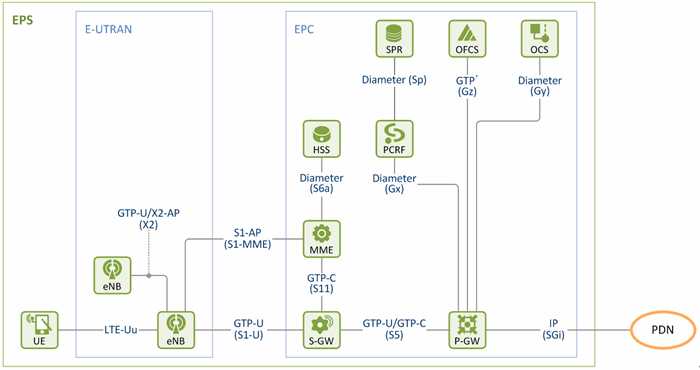
1. The Radio Team (E-UTRAN)
This is the part you can see (your phone and the tower).
- UE (User Equipment): This is your mobile device.
- eNB (eNodeB): This is the LTE base station (the tower). Role: It provides the radio interface to your phone. It is responsible for Radio Resource Management (RRM), which means it acts like a traffic cop, deciding which user gets radio resources (scheduler), managing signal strength measurements, and handling handovers.
2. The Core Team (EPC)
This is the “Brain” and the “Plumbing” hidden behind the tower. The document lists the key players in Table 2:
A. The “Brain” (Control Plane) These entities handle the signaling (setting up the call, checking if you are allowed to connect), but they don’t touch your actual YouTube video data.
- MME (Mobility Management Entity): The most important control node. Role: It authenticates you (checking with the HSS), tracks where you are (Mobility Management), and sets up the data tunnels. It talks to the eNB via the S1-MME interface.
- HSS (Home Subscriber Server): The master database. Role: It stores your user profile, subscription info, and the “secret keys” used to authenticate you. The MME consults the HSS to see if you are a paying customer.
- PCRF (Policy and Charging Rules Function): The rule maker. Role: It decides your Quality of Service (QoS). For example, if your plan limits your speed or if you are a VIP user, the PCRF tells the network how to treat your traffic.
B. The “Plumbing” (User Plane) These entities actually carry your data packets (internet traffic).
- S-GW (Serving Gateway): The local anchor. Role: It acts as the anchor point for your data when you move between different towers (eNBs). If you are in a car moving across the city, your eNB changes, but your S-GW usually stays the same so your connection doesn’t drop.
- P-GW (PDN Gateway): The exit door. Role: This is the gateway to the outside world (PDN/Internet). It assigns your IP address. It also enforces the rules set by the PCRF (like throttling speeds) and handles billing.
3. The Interfaces (The Cables)
The document briefly introduces the connections (Interfaces) between these boxes in Table 3. A key takeaway for your slides is the difference between:
- S1-MME: The “Control” line between Tower and Brain (eNB MME).
- S1-U: The “Data” line between Tower and Plumbing (eNB S-GW).
4. Control Plane vs User Plane
Control Plane Responsible for establishing, maintaining, and terminating connections between the user equipment (UE) and the network. It handles signaling and control functions, ensuring that data can flow smoothly.
Tasks:
- Authentication and Authorization: Ensures the UE is authorized to access the network.
- Mobility Management: Manages handovers between cells to maintain connectivity.
- Radio Resource Control: Allocates channels and power levels.
- QoS Management: Ensures the quality of service for different data streams.
- Signaling for Call Setup and Release: Manages the initiation and termination of calls.
User Plane Responsible for the actual transmission of user data, such as web browsing traffic, voice calls, video streaming, and file downloads. It’s the path where the actual content flows. Tasks:
- Data Forwarding: Transports data between the UE and the core network.
- Packet Routing and Switching: Manages the path that data packets take through the network.
- QoS Enforcement: Ensures that user traffic meets the required QoS levels.
- Encryption and Decryption: Secures user data during transmission.