1. User plane protocol stacks
This section details exactly how your data (like a video stream) is packaged and transported.
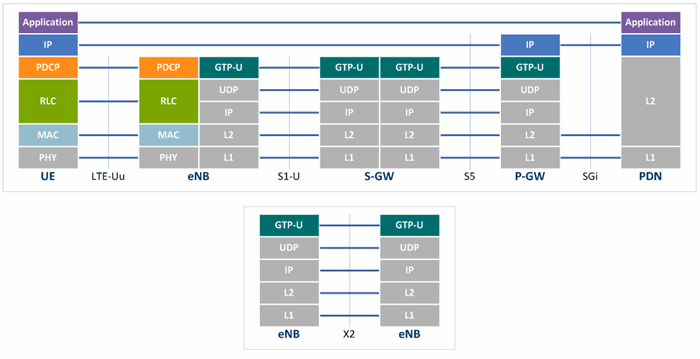
1. The Air Interface (UE to eNB)
The most complex part of the user plane happens over the radio link between your device and the cell tower. The protocols used here ensure that data is transmitted reliably and securely over a medium (air) that is prone to interference.
- PDCP (Packet Data Convergence Protocol):
- Header Compression: IP headers (like IPv6) are large. PDCP uses Robust Header Compression (RoHC) to shrink these headers, saving valuable radio bandwidth.
- Ciphering: It encrypts your data so it cannot be intercepted over the air.
- RLC (Radio Link Control):
- Segmentation and Reassembly: RLC breaks down large IP packets into smaller pieces that fit into the “time slots” available on the radio channel, and puts them back together at the other end.
- Error Correction: It uses an Automatic Repeat Request (ARQ) mechanism to retransmit any pieces of data that are lost during radio transmission.
- MAC (Medium Access Control):
- Scheduling: The MAC layer at the eNB decides which user gets to transmit data at any given millisecond.
- HARQ (Hybrid ARQ): This is a fast “low-level” error correction that works with the Physical layer to quickly fix transmission errors.
- PHY (Physical Layer): This is the actual radio hardware level. It handles the modulation (converting bits into radio waves) and the actual transmission of the signal.
2. The Core Network (eNB to P-GW)
Once your data reaches the eNB, it is “wired.” The protocols here focus on “tunneling” your data so it reaches the right destination while you are moving.
- GTP-U (GPRS Tunnelling Protocol for User Plane):
- This is the most critical protocol in the core. It “wraps” (encapsulates) your IP packet inside another IP packet.
- This allows your data to be “tunneled” from the eNB to the S-GW and then to the P-GW. Because of this tunnel, the rest of the internet only sees your IP address at the P-GW, even as you move from one cell tower (eNB) to another.
- UDP/IP: The GTP-U tunnels themselves are carried over standard UDP/IP protocols within the provider’s internal network.
3. End-to-End Flow Summary
When you send a request (like opening a website), the process follows this chain:
- UE: Your app creates an IP packet. The PDCP/RLC/MAC layers prepare it for radio transmission.
- eNB: Receives the radio signal, strips off the radio headers, and wraps your IP packet into a GTP tunnel.
- S-GW: Receives the GTP tunnel and forwards it toward the P-GW.
- P-GW: Removes the GTP “wrapper” and sends your original IP packet out to the public Internet.