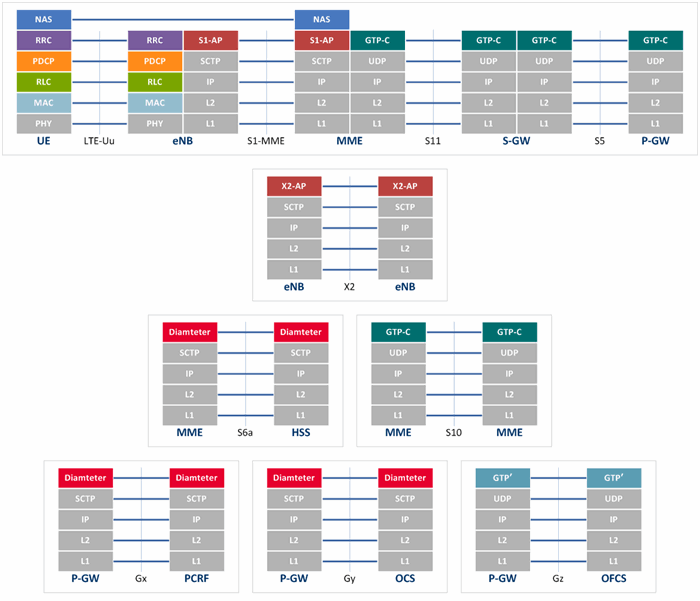
The control plane handles the signaling required to set up, maintain, and tear down connections. It ensures the User Equipment (UE) can authenticate, move between towers (handover), and receive the correct Quality of Service (QoS).
1. Radio Interface (LTE-Uu)
This is the air interface between your phone (UE) and the base station (eNB).
- NAS (Non-Access Stratum):
- This is the highest layer of the control plane stack on the radio side.
- Function: It handles Mobility Management (tracking where the user is) and Bearer Management (setting up data paths). Note: NAS signaling travels transparently through the eNB to the MME; the eNB does not interpret it.
- RRC (Radio Resource Control):
- This protocol supports the transfer of NAS signaling and manages the radio resources.
- Key Functions:
- Broadcasting system information.
- Setup, reconfiguration, and release of RRC connections.
- Setup, modification, and release of radio bearers.
2. Inter-eNB Interface (X2)
This interface connects two base stations (eNBs) directly, allowing them to talk to each other. X2AP (X2 Application Protocol):
- Function: Supports UE mobility (handovers) and SON (Self-Organizing Network) functions.
- Mobility: It handles user data forwarding and the transfer of Sequence Number (SN) status during handover.
- SON: eNBs use this to exchange traffic load info and coordinate mobility parameters to optimize the network automatically.
3. E-UTRAN to Core Interface (S1-MME)
This connects the base station (eNB) to the control brain of the core network (MME). S1AP (S1 Application Protocol):
- Function: Supports S1 interface management, transport of NAS signaling, and UE context management.
- Context Management: It delivers the initial UE context to the eNB to set up E-RABs (E-UTRAN Radio Access Bearers) and manages them thereafter.
4. Core Network Tunneling Interfaces (S11, S5, S10)
These interfaces connect the various gateways and management entities within the Evolved Packet Core (EPC). GTP-C (GPRS Tunneling Protocol - Control):
- Function: Exchanges control info to create, modify, and terminate GTP tunnels.
- Handover: It is responsible for creating data forwarding tunnels when a user moves between towers (handover).
- Used on:
- S11: Between MME and S-GW.
- S5: Between S-GW and P-GW.
- S10: Between MME and MME (for handovers).
5. Authentication and Policy Interfaces (S6a, Gx, Gy)
These interfaces use the Diameter protocol, which is the standard for authentication, authorization, and accounting (AAA) in LTE.
- S6a Interface (HSS ↔ MME):
- Protocol: Diameter.
- Function: Exchanges subscription data and subscriber authentication info so the network knows who the user is and what they are allowed to do.
- Gx Interface (PCRF ↔ P-GW):
- Protocol: Diameter.
- Function: Delivers PCC rules (Policy and Charging Control) from the PCRF to the P-GW. This dictates the QoS (speed/priority) and charging rules for the user.
- Gy Interface (OCS ↔ P-GW):
- Protocol: Diameter.
- Function: Exchanges real-time credit control information. This is critical for prepaid users to ensure they have enough credit for the service.
6. Offline Charging Interface (Gz)
This interface connects the gateway to the offline charging system. Gz Interface (OFCS ↔ P-GW):
- Protocol: GTP (specifically GTP’ is often used, though the text simply says GTP).
- Function: Transfers CDRs (Call Detail Records) from the P-GW to the OFCS for billing purposes.